17 October 2020

Angela again

 I painted Angela Davis's portrait once before, but that was when I was still striving for realism, so I decided to paint her again in my new style. I wanted it to be a sort of companion piece to James Baldwin, but not in the same colors I used for him, so I studied photos of her and decided on a color combination of yellow, orange, and purple. It wasn't that she ever dressed in those bright colors—quite the contrary, she seems to favor grays and greens—but that I saw something bright in her face that asked for them.

I went farther than I had planned with the hair treatment, and I really wish I had stopped where my first impulse said to, where it was more indicated and less specific. Her eyes are larger than in life, but that goes along with the new methods; I'm hoping that in this case it didn't render her less recognizable. Anyway, I guess the quote will take care of that, even if the likeness isn't perfect.

Daler Rowney inks, pencil, white gesso, Uniball Vision, white gel pen, on 140-lb. Fluid watercolor paper, 9x12 inches.


14 October 2020

Back to basics

 I wanted to paint something tonight, but I wasn't led in any particular direction. Lots of people on my class site have been doing Inktober, which I avoid because I don't like just drawing in ink, I want to do full paintings, mostly, and also I never "feel" the prompts they offer. But I have to admit that I've been liking some of the more spare ink drawings I've been seeing, so tonight I decided to do a combination of pattern, spatter, and random line and let it all dictate a face for me. (I also didn't want to stay up until 2:00 a.m.!)

This is sort of going back to basics with what Deb Weiers teaches, with a combination of random background and blind contour drawing. I didn't do this one blind, but I did let the location of the lines and circles dictate the face. I also started drawing the connectors with my Uniball, but it was just too "civilized" next to the random stuff, so I drew the rest by dipping the wooden end of my brush in the ink and scrawling/scribbling with it. I had fun!

The red stuff at the top was an experiment that didn't work out very well. I had a piece of packing material that was a sort of diamond-patterned styrofoam-like webbing, and I thought it would be brilliant for texture to tape it down and paint through the holes; but because it's thick and bouncy, the ink connected with the material but not with the paper and didn't give a nice clean pattern. So I threw in some circles and shapes and outlined them to accentuate the red a little more.

Her name is Sukie, and her attention span is, shall we say, fluid at the moment...

Daler Rowney inks, India ink, gel pen, on Fluid 140-lb. watercolor paper, approx. 9x12 inches.


10 October 2020

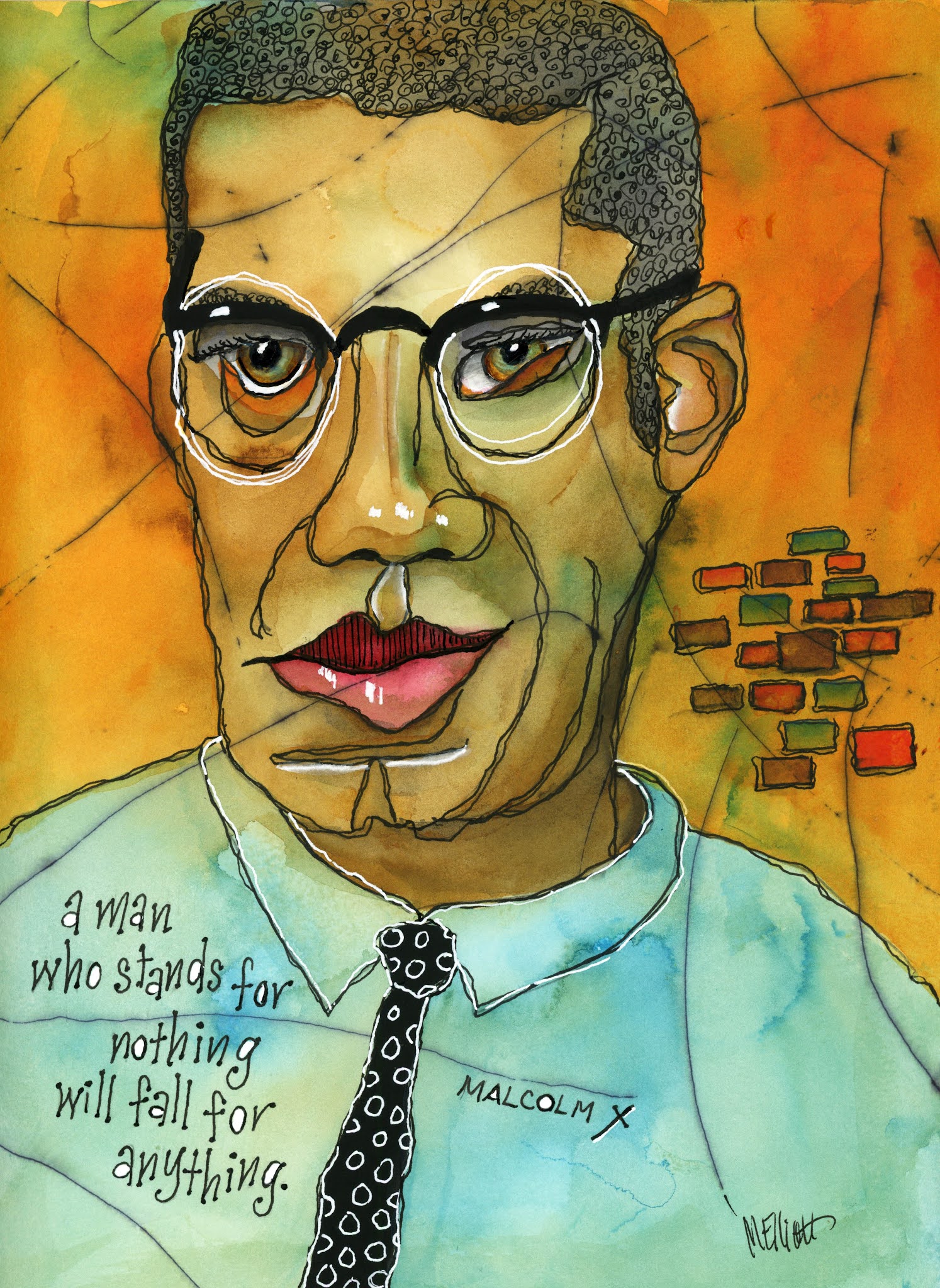
Stand

 Malcolm X said "A man who stands for nothing will fall for anything." While he is not a specific hero of mine, and while I disagreed with a lot of his methods (and his religion), I believe Malcolm Little (his original name, ironically, considering the stature he achieved) was one of those who was willing to stand. To stand up, to stand firm, to stand for something when others would not. I came across that quote and it resonated, considering the two-faced duplicity and constant fickle changeability of more than half of our politicians at this present moment in history.

I believe we all need to decide where we stand and with whom, and take up that charge with seriousness and consistency, or we are all in danger of falling. The MAGA contingent has already done so, for a shyster who has stolen their money and their good will for his own benefit and given back nothing but false pride in a nonexistent superiority that only increases their hatred. Let us see their example, mind Malcolm's words, and find a different ground to stand on.


Gel pen, pencil, Daler Rowney inks, gesso, Paul Jackson watercolors, Uniball pen, white Signo gel pen, on Fluid 140-lb. watercolor paper, 9x12.


08 October 2020

"Real" men

 After painting the Terrible Triumvirate, I felt like I needed some kind of relief, that I needed to paint somebody normal, or maybe even someone heroic. I didn't know who that would be, though, so I pondered various icons I could choose, but nobody seemed just right. I opened up my Reference Photos folder and started clicking through it, looking for a face.

The face I found was that of a farmer, in a blue chambray shirt and overalls, with sun-dug wrinkles around his eyes, a white frosting of whiskers on his hollowed cheeks and chin, and a look that said simultaneously, I'm so worn out, and yet I'm looking at this blue sky and these fields and feeling satisfied. 

I come from a fairly long line of farmers, although nobody in my parents' generation stuck with it. My mom was the youngest of nine children, and by the time her parents passed when she was 10 and 12, her brothers and sisters had all left their truck farm in Virginia—some for the military (it was World War II), some to get married and start their own households—and there was no money left to keep things going. Others bought the farm, and she lived with a sister for a while, then married an Air Force guy and followed him around the globe for 20 years before settling in the "Inland Empire," otherwise known as Riverside, California.

My dad was the middle child of five, and although his parents owned a good-sized farm in Oklahoma, his mother had bigger plans for her children. The two eldest, the girls, went to school and became school teachers; Joe (my dad) ran off at 17 and joined the Army Air Corps; and the two little boys, 10 years behind the other three, also taught, one in high school and one in college. Grandmother and Granddad sold the farm and bought a couple of acres in town, where Allie grew corn and beans and strawberries and Granddad went to local auctions and spent their money on whatever took his fancy that week. So except for a few visits to their farm when I was very small, I was never immersed full-on in that life. My dad eventually retired from the Air Force and became a house builder, so I know more about dry wall and paint than I do about farming.

I did pick vegetables with Grandmother, I did can them, I did ride horses and feed chickens with Granddad, and I eventually learned to quilt (though long after I could have learned something from Allie, sadly), and I have a few fruit trees, an herb garden, some summer tomatoes, and a zucchini plant or two on my suburban lot, but that's the extent of my industry.

I think the farmers—particularly the ones who hold on year after year against the wiles of the major farming corporations trying to add more land to their empires—are heroic. It's a profession that is so dependent on random chance, on wind and weather being just right at the just right time, and no matter how hard they work or how carefully they plan, hoard seed, grow fodder, rotate fields, it can all be ruined by one torrential rain or one month of unseasonal heat. So it made me feel happy to paint this guy, who never wears a suit and tie except maybe on Sunday, and who listens to the land, and whose ambitions are small but more important to him and his neighbors and his customers than any exhibited by the Triumvirate in their halls of injustice. I hope he has the sense to vote for the right person in this election, knowing that he is one of those who will receive help and comfort.

Pencil, Daler Rowney inks (Scarlet, Indian Yellow, Purple Lake), gesso, Paul Jackson watercolors, Uniball pen, India ink, on Fluid 140-lb. watercolor paper, 9x12 inches.

03 October 2020

Just men

 I was thinking about the overweening greed and ambition of certain members of our government tonight, and also about how much harm they have been able to do in the four short years in which they have been calling the shots. I felt the need to remind myself that they are not all-powerful in a forever sense, but have only been able to take foul advantage of the temporary situation in which they found themselves. Although they are master manipulators, they have also benefited from sheer luck, i.e., a narrow party majority, and as soon as that party majority is gone, so will be their advantage. I said to myself, reassuringly, "They are just men, like any others."

And then I thought about that statement and realized that I would need to clarify, because although they are just men, they are not just men. They do not play fair, they do not honor their word, they are hypocrites of the first order and will say and do whatever it takes to keep their power, their privilege, their control. So no, they are not just men. But they are only men, and someday—soon—they will fall.

Also, they all have thin lips.

Gel pen, Daler Rowney inks (Indian Yellow and Burnt Umber), pencil, Uniball pen, Paul Jackson watercolors, white gel pen, on 140-lb. Fluid watercolor paper, 9x12.


01 October 2020

The right speaker

There are people who have words for a particular situation that make you stop, sit up, and pay attention. James Baldwin is one of those. And although the things he said were certainly applicable during his lifetime, they also seem peculiarly addressed to us now, in our current situation.

I sat through the so-called presidential debate last night watching the man in charge of our collective welfare bully his opponent mercilessly and maliciously, and lie through his teeth over and over again with a confident smirk on his face. Tonight I went looking for some way to address him through my art, and got a helping hand from Baldwin. This statement is so simple, yet so starkly true. It echoes the quote I love from Maya Angelou, that "when people show you who they are, believe them," and states my exact response to our leadership: "I can't believe what you say, because I see what you do."

It also, of course, addresses the other revolution taking place in our country right now, which is the effort to see what we do to the black lives among us and choose to do better. Dual purpose Baldwin, you might say.


I owe the background color scheme to a piece Deb Weiers just finished and posted, although mine is a little tamer. But I think it works well in contrast to the purple. Other than color and a little exaggeration and flourish here and there, I stayed pretty realistic with this one; Baldwin has such an expressive face that not much extra is needed to render it unique.

Pencil, gel pen, Daler Rowney inks, Paul Jackson watercolors, white gesso, Uniball pen, white gel pen, on 140-lb. Fluid watercolor paper (my order from Dick Blick showed up, yay!), 9x12 inches (clipped a little by the scanner).

29 September 2020

The significance of stripes

 Now that I have started thinking about art in terms of mixed media and am taking collage into consideration, I see things with new eyes. I came across this roll of Christmas paper striped red and cream and thought, Wouldn't that make a wonderful shirt for one of my pieces? Of course, stripes are usually associated with one of two characters: prisoners, or pirates. If I had thought of pirates first, this piece might have been quite different, but prisoner was what came to mind. Initially (because of the state of the world and my own current animosities) I thought of who I would like to PUT in prison, but honestly, I couldn't face reproducing that image, even for the sake of parody. So then I started thinking about people who had been to prison, and been sent there unjustly, and Oscar Fingal O'Flahertie Wills Wilde popped into my mind.


Oscar Wilde is best remembered for three things: His plays (my favorite is The Importance of Being Earnest), his book The Picture of Dorian Gray, and his criminal conviction for homosexuality. He was "known for his biting wit, flamboyant dress, and glittering conversational skill," so I imagine he would carry off prison stripes with flair, as here.

Wilde died tragically young, at 46, from meningitis, which it is speculated was caused by an untreated inner ear injury sustained while serving his two-year prison sentence. In 2017, he was among approximately 50,000 men pardoned under the Alan Turing law for homosexual acts that were no longer considered offenses.

After his prison term, he wrote in De Profundis,

To regret one's own experiences is to arrest one's own development. To deny one's own experiences is to put a lie into the lips of one's own life. It is no less than a denial of the soul.
Pencil, Daler Rowney inks, watercolor, collage, Uniball pen, white gesso, white gel pen, on 140-lb. Canson watercolor paper, approx. 8.5x11 inches.

NOTE: Upon further reflection, I felt that the original striped eye looked too much like an awning or a circus tent with the vertical stripes, and distracted from the rest of the page. So I gesso'd it out and made the stripes horizontal to go along with the shirt, also knocking down the white to a beige. I think it's an improvement—regrets to anyone who disagrees with me...